Call for Papers
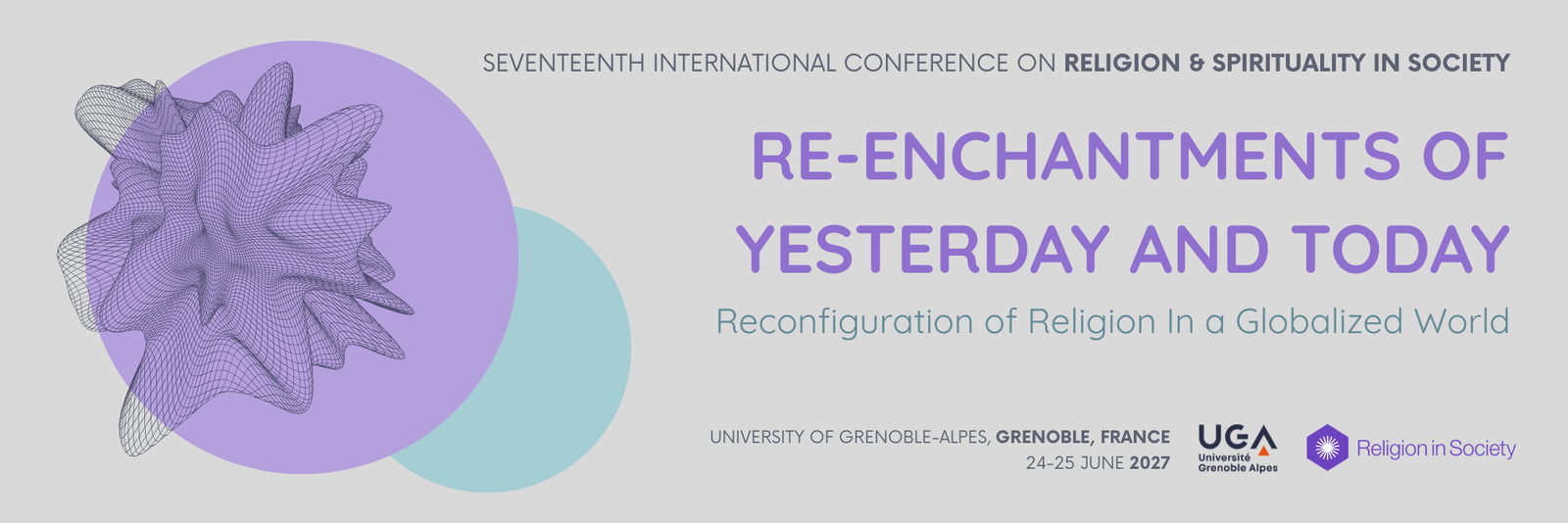
The Religion in Society Research Network invites proposals for the Seventeenth International Conference on Religion & Spirituality in Society, to be held 24–25 June 2027, hosted by the University of Grenoble-Alpes, Grenoble, France.
The Seventeenth International Conference on Religion & Spirituality in Society brings together researchers, educators, practitioners, writers, religious leaders, and community stakeholders concerned with religion, spirituality, belief, ritual, ethics, and secularism as social, cultural, political, and mediated phenomena. The annual conference serves as a key meeting point for interdisciplinary inquiry into how religious and spiritual practices, institutions, identities, and imaginaries are being reshaped across diverse local and global contexts.
Special Focus and Conference Themes
The focus of the 2027 conference is on the transformation of the global religious landscape. In many regions, this landscape is characterized by a dual dynamic: on the one hand, a certain decline in religious institutions; on the other, a revival of individual practices. These practices sometimes take alternative forms, marked by a neo-spirituality and new rituals born of hybrid beliefs, contemporary syncretism, transcultural borrowings, digital practices, and community gatherings. In the face of these emerging hybridizations, traditional religious forms nevertheless persist and are not left behind: they, too, are evolving and adapting.
Religious traditions are indeed evolving and interacting with these new forms of expression, thereby helping to reshape the relationships between religion, society, and politics. Religions directly influence state institutions, legislation, and public debates. But they also express themselves indirectly, through the mediation of imaginaries, symbols, and cultural practices. These multiple interactions complicate the narrative of secularization as the “disenchantment of the world” and thus as the “metabolization” of religious functions across all social spheres, including the political. Studying these dynamics involves considering how religion can both support and challenge power structures, how it contributes to the construction of collective identities and the regulation of social relations, and how it is embedded in conflicts or movements for social transformation.
This conference invites participants to explore the expressions, discourses, representations, and languages, as well as the cultural circulations and translations that result from these processes. The question, then, is to understand how new religious imaginaries are shaped, and to what extent they interact with political, social, and cultural dynamics.
Conference themes:
- Continuities, Revitalizations, and Adaptations of Religious Traditions: Liturgical renewal, doctrinal reconfigurations, strategies for adapting to social expectations and contemporary contexts, and tensions between continuity and innovation.
- Religious Hybridizations and Syncretism: Circulation of beliefs, permeability of practices, and reinvented esotericisms.
- Discourses, Narratives, and Mediations of Re-enchantment: Spiritual narratives in media, television series, literature, film, music, and video games.
- Digital Practices and (Re)Connected Spiritualities: Religion and the influence of social media, the staging and spectacularization of beliefs, new digital rituals, spiritual influencers, AI, and divinatory practices.
- Eco-spiritualities, Ecological Re-enchantment, and New Experiential Relationships: Fusions of ecology and religion, contemporary animisms, and the revitalization of indigenous cosmogonies in a globalized world.
- Translation, Transmission, and Transformation of Syncretic Practices: Ritual, symbolic, and linguistic translations of belief; cultural adaptation; and local reinterpretations of practices and cults.
- Spiritualities and medicine (alternative and/or traditional): Spirituality through the lens of well-being, holistic practices and spiritualities, the role of religion and spirituality in care, therapeutic culture(s) and spirituality.
- Religions and Politics: Interactions, reconfigurations, mobilizations, secularization, forms of secularism, the religious dimension and the public sphere.
Alongside the special focus, the conference welcomes proposals that address broader questions of religion, spirituality, secularity, belief, ritual, identity, ethics, mediation, and community in contemporary societies.
Knowledge Experience
The conference is organized as a hybrid knowledge experience, integrating in-person and online participation within a unified scholarly environment. Each presentation is supported by a Presentation Page, available to registered delegates as a key feature of participation. These pages allow presenters to share abstracts, media, and reflections, while giving delegates, especially those participating online, a central space to access content and engage in discussion before, during, and after the event.
In-person sessions in Grenoble are interwoven with live online presentations and asynchronous contributions within a single integrated program. Regardless of participation mode, all delegates have access to the full schedule, session media, and a growing digital archive. Across formats, the emphasis is on reciprocal, human-scale exchange—conversation, reflection, and collaborative inquiry rather than one-way presentation.
Publication Pathways
Presenters at the conference may choose to develop their work for publication in The International Journal of Religion and Spirituality in Society and related book imprints of the Religion in Society Research Network.
Who Should Attend
We invite interdisciplinary proposals from the humanities, social sciences, arts, and related fields. We welcome proposal submissions for papers, workshops, colloquia, posters, and practice-based presentations. The conference offers an interdisciplinary forum for examining the continuities and transformations of religion and spirituality in a globalized world.
Sincerely,
Marion Le Corre-Carrasco, Conference Chair, Professor, University of Grenoble-Alpes, Grenoble, France
Dr. Luis G. Roger-Castillo, Research Network Chair, University of Jaén, Spain
Dr. Phillip Kalantzis-Cope, Chief Social Scientist, Common Ground Research Networks, United States of America